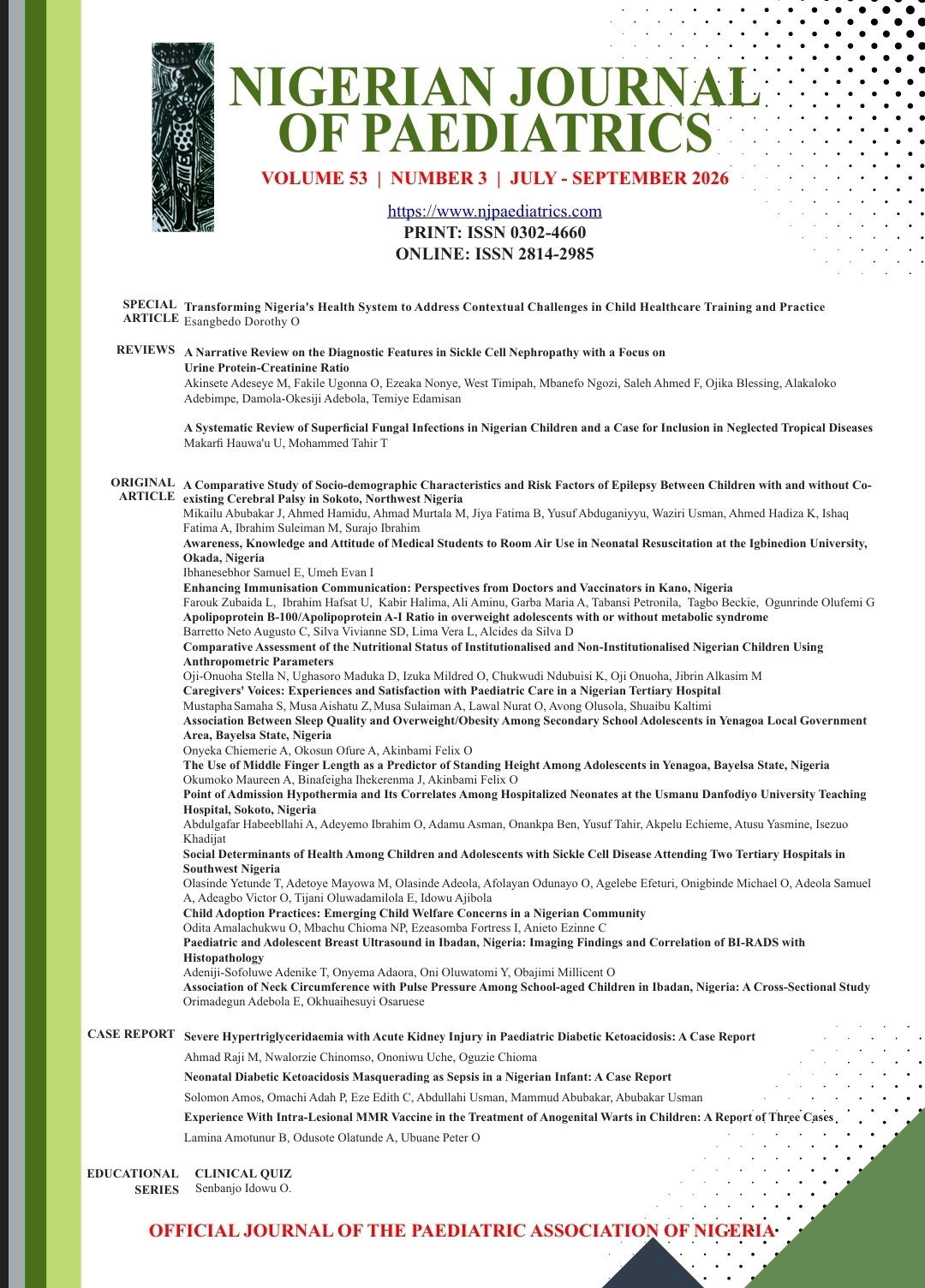
Awareness, Knowledge and Attitude of Medical Students to Room Air Use in Neonatal Resuscitation at the Igbinedion University, Okada, Nigeria
DOI:
https://doi.org/10.63270/njp.v53i3.2000074Keywords:
Room air, neonatal resuscitation, awareness, medical students, oxygen concentration.Abstract
Background: A substantial proportion of neonatal deaths is due to preventable causes related to birth asphyxia and inadequate newborn resuscitation, especially in low- and middle-income countries (LMICs). Historically, 100% oxygen was routinely administered during neonatal resuscitation. However, evidence over the past two decades has demonstrated that the use of room air (21% oxygen) during initial resuscitation improves survival.
Objective: To assess the level of awareness, knowledge, and perception regarding the use of room air in neonatal resuscitation among medical students in Nigeria.
Method: A descriptive, cross-sectional survey was conducted among clinical medical students at Igbinedion University, Okada, Nigeria. The questionnaire was offered to all students in the three clinical classes; the participants responded via a self-administered structured questionnaire developed from international guidelines, completed anonymously over one month.
Results: Of the 151 respondents, 84.1% correctly identified 21% oxygen as the recommended concentration to initiate resuscitation. Awareness was significantly associated with educational level (87.2%), clinical rotations (88.9%; 72/81), observation (91.5%; 97/108), and practice (86.4%; 57/66) of neonatal resuscitation. Formal training on neonatal resuscitation was also related to better awareness (90.3%; 56/62).
Conclusion: Most medical students were aware of room air use in neonatal resuscitation, although gaps in this knowledge still exist. Enhanced training and simulation-based learning are required to improve adherence to current established practice guidelines.
Downloads
Published
Issue
Section
License
Copyright (c) 2026 NIGERIAN JOURNAL OF PAEDIATRICS

This work is licensed under a Creative Commons Attribution 4.0 International License.
This is an open-access journal, and articles are distributed under the terms of the Creative Commons Attribution 4.0 License, which allows others to remix, transform, and build upon the work even, commercially, as long as appropriate credit is given to the author, and the new creations are licensed under identical terms