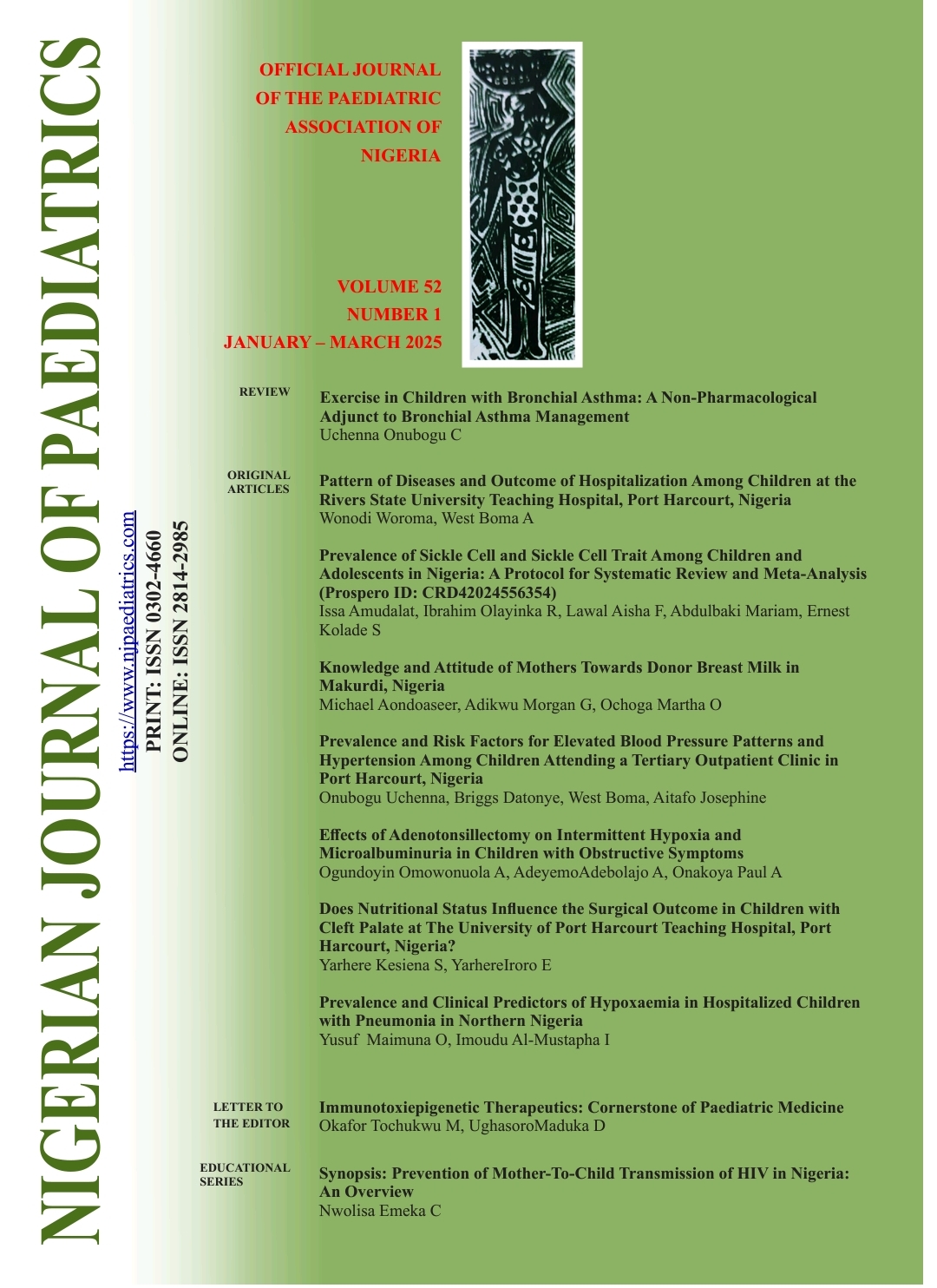
Knowledge and Attitude of Mothers Towards Donor Breast Milk in Makurdi, Nigeria
DOI:
https://doi.org/10.63270/njp.2025.v52.i1.2000004Keywords:
Breastmilk, Breastfeeding, Donor milk, HIV, Milk bank, Nursing mothersAbstract
Background: Breastfeeding is one of the most effective ways to ensure a child's health and survival. Improving breastfeeding practices could save the lives of more than 800,000 under-five children every year, the vast majority of whom are under six months of age. Early exposure to maternal antibodies, lactoferrin, oligosaccharides and other protective components in breast milk may improve neonatal and infant immune function. Mother's milk is widely recognized as the optimal feeding for term infants but also provides vital health benefits for sick and preterm infants. When mother's milk is unavailable, or in short supply, donor human milk is the second best alternative.
Objective: To determine mothers' knowledge of and attitudes toward donor breast milk.
Methods: A cross-sectional, descriptive study of 403 mothers attending antenatal/immunization clinics was conducted from September 2022 to January 2023. Data was collected using an interviewer-administered questionnaire.
Results: While 36.5% (n = 147) of mothers had heard about donor breast milk, 67.2% (n = 271) of the mothers were willing to donate their breast milk, but only 37.2% (n = 150) agreed to accept donor breastmilk for their baby. Knowledge about donor breast milk was significantly associated with educational status (p = 0.036), and the willingness to donate was significantly associated with knowledge (p = 0.015).
Conclusion: Mothers' education is a key factor influencing both knowledge and willingness to donate breastmilk.
Downloads
Published
Data Availability Statement
research data will be provided on request
Issue
Section
License
Copyright (c) 2025 NIGERIAN JOURNAL OF PAEDIATRICS

This work is licensed under a Creative Commons Attribution 4.0 International License.
This is an open-access journal, and articles are distributed under the terms of the Creative Commons Attribution 4.0 License, which allows others to remix, transform, and build upon the work even, commercially, as long as appropriate credit is given to the author, and the new creations are licensed under identical terms