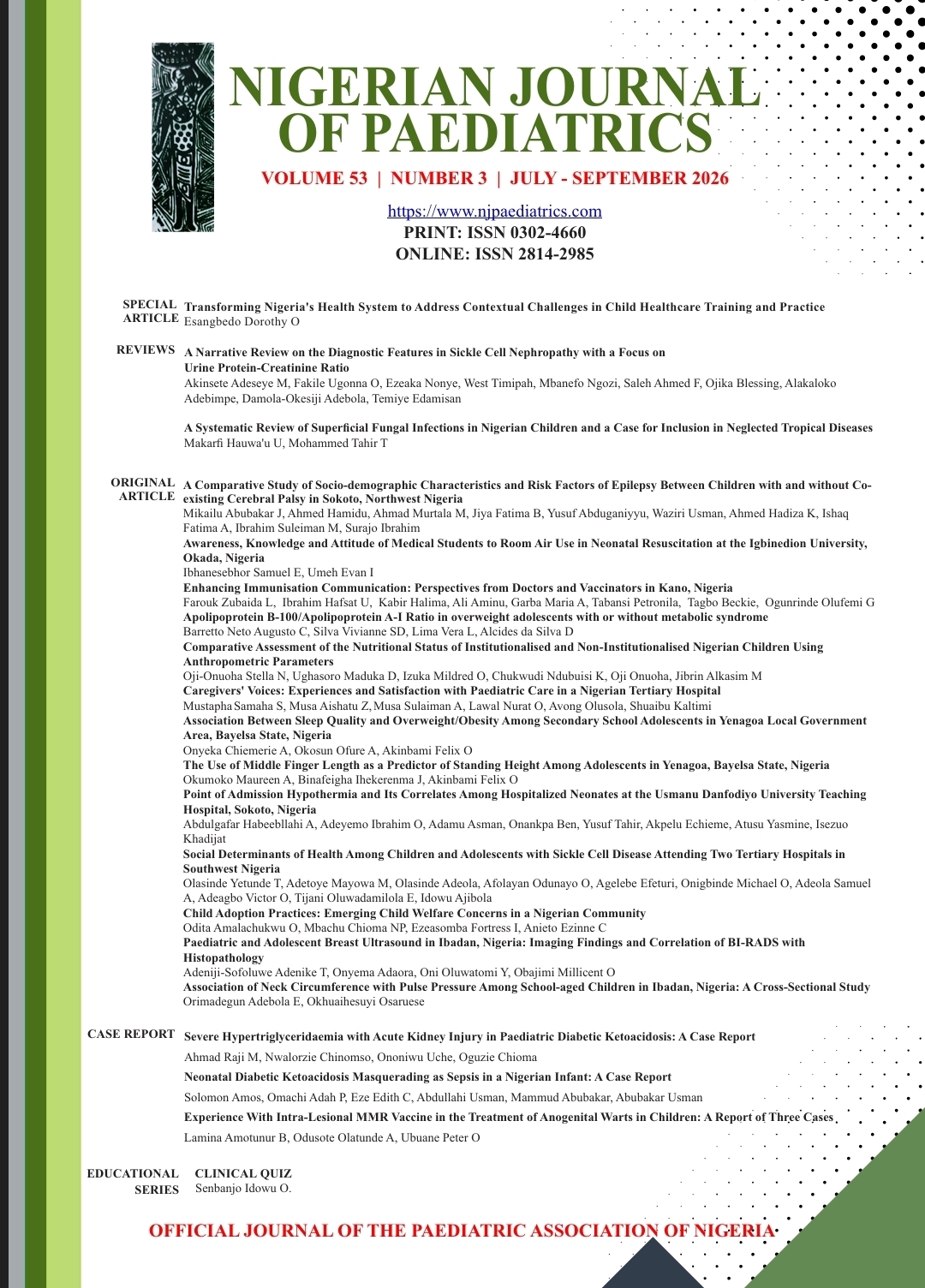
Middle Finger Length as a Predictor of Standing Height Among Adolescents in Yenagoa, Bayelsa State, Nigeria
DOI:
https://doi.org/10.63270/njp.v53i3.2000080Keywords:
Middle finger length, standing height, adolescents, Yenagoa, NigeriaAbstract
Background: Accurate height measurement is crucial for paediatric nutritional assessment, growth monitoring, and clinical decision-making. When direct measurement is difficult, surrogate anthropometric indicators such as middle finger length (MFL) may provide practical alternatives.
Objectives: To evaluate the relationship between MFL and standing height among adolescents in Yenagoa, Bayelsa State, and to develop predictive equations including sex- and age-specific models.
Methods: This cross-sectional study included 1,222 adolescents (10–19 years) from selected secondary schools. Standing height and MFL were measured using WHO-standardized procedures. Pearson correlation assessed the relationship, and linear regression produced predictive equations. Analyses were performed for the total population, by sex, and across three age groups (10–13, 14–16, 17–19 years). Agreement between measured and predicted height was assessed using Bland-Altman analysis
Results: A moderate positive correlation was observed between MFL and height (r = 0.672, p < 0.001). The overall predictive equation was Height = 89.782 + 8.819(MFL) (R² = 0.452). Sex-specific models demonstrated slightly higher correlation in males (r = 0.685) than in females (r = 0.659). Age-stratified analyses showed stronger correlations in older adolescents.
Conclusion: MFL is a practical predictor of standing height in Nigerian adolescents. Sex- and age-specific models improve predictive accuracy, offering utility in clinical, public health, and forensic contexts.
Downloads
Published
Data Availability Statement
The research data can be made available on request
Issue
Section
License
Copyright (c) 2026 NIGERIAN JOURNAL OF PAEDIATRICS

This work is licensed under a Creative Commons Attribution 4.0 International License.
This is an open-access journal, and articles are distributed under the terms of the Creative Commons Attribution 4.0 License, which allows others to remix, transform, and build upon the work even, commercially, as long as appropriate credit is given to the author, and the new creations are licensed under identical terms