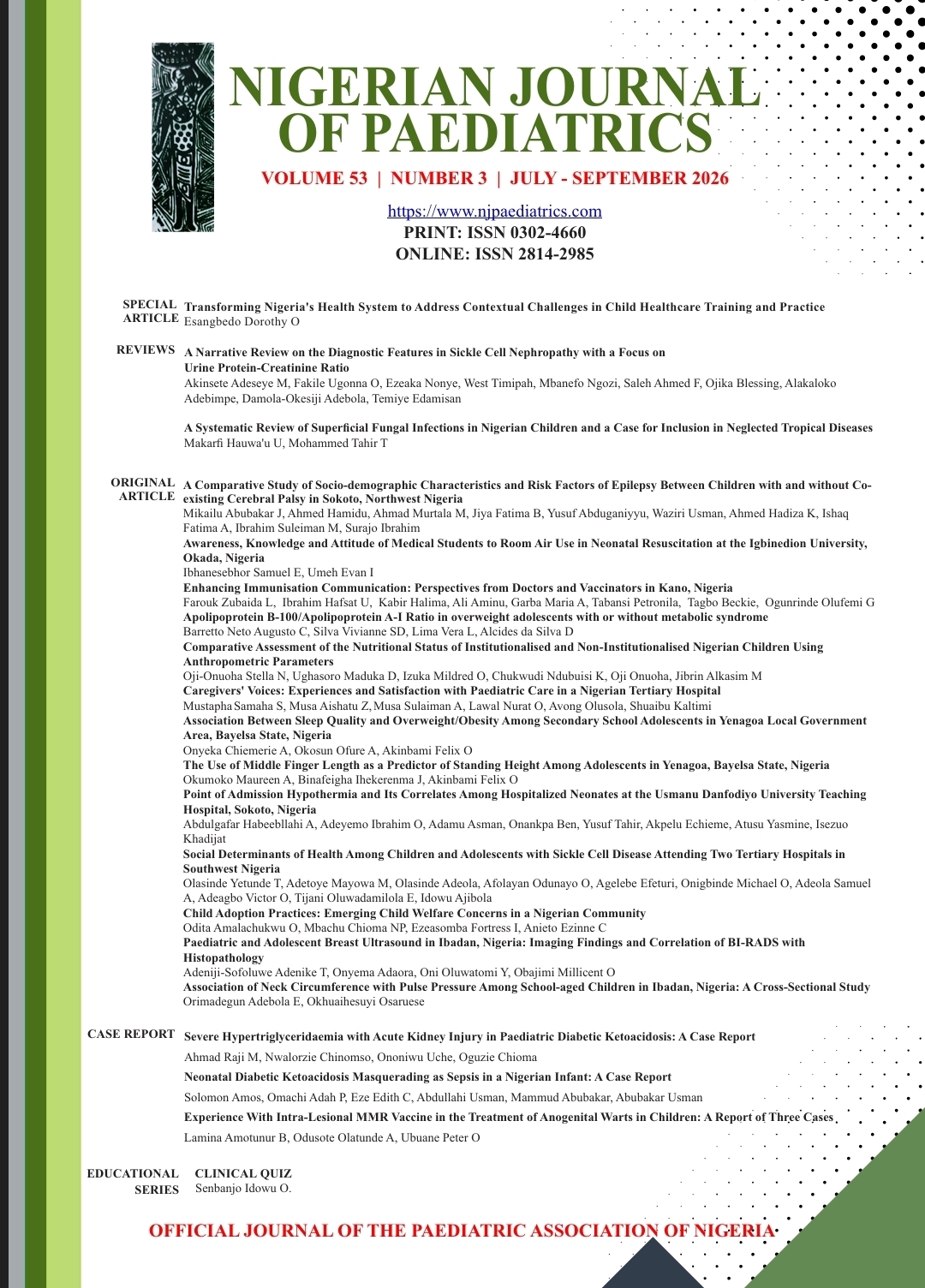
Child Adoption Practices: Emerging Child Welfare Concerns in a Nigerian Community
DOI:
https://doi.org/10.63270/njp.v53i3.2000083Keywords:
Adoption practices, Adoptive mothers, Child Health, Child protection, Counselling services, NigeriaAbstract
Background: Adoption in Nigeria operates within statutory and customary frameworks, yet informal practices, limited legal awareness, and inadequate counselling persist.
Objective: To explore adoption practices and emerging child welfare concerns in Onitsha, Nigeria, with emphasis on legal, psychosocial, and health dimensions.
Methods: A descriptive, cross-sectional study was conducted among 62 adoptive mothers recruited through consecutive and snowball sampling. Data were collected using a pre-tested, interviewer-administered questionnaire covering socio-demographics, adoption processes, counselling, legal awareness, and child health outcomes.
Results: Most adoptive mothers (48.4%) were aged 45–54 years; 85.5% were married and 69.4% had university education. The majority of adoptees were male (69.4%) and aged 0–5 years (73.8%), with 41.9% adopted on the first day of life. Primary reasons for adoption were absence of biological children (43.5%) and desire for a male child (22.6%). While 35.2% of adopters followed official procedures, 31% reported obtaining a child through informal payments to health workers. Only 41.9% received pre-adoption counselling, and 56.5% did not undertake routine post-adoption medical checks. Reported child health challenges included neonatal jaundice, sepsis, developmental delay, cerebral palsy, seizures, malnutrition, and one mortality from congenital heart disease. Despite these challenges, 95.2% reported strong family support for child adoption.
Conclusion: Adoption in Onitsha reflects a complex interplay of cultural preference, infertility-related motivations, informal practices, and limited health screening. Strengthening regulatory oversight, mandatory counselling, and structured post-adoption medical support are critical to safeguard child welfare and optimise family outcomes.
Downloads
Published
Data Availability Statement
The research data can be made available on request.
Issue
Section
License
Copyright (c) 2026 NIGERIAN JOURNAL OF PAEDIATRICS

This work is licensed under a Creative Commons Attribution 4.0 International License.
This is an open-access journal, and articles are distributed under the terms of the Creative Commons Attribution 4.0 License, which allows others to remix, transform, and build upon the work even, commercially, as long as appropriate credit is given to the author, and the new creations are licensed under identical terms